
Choosing Between Vertical and Horizontal Machining Center
In today’s precision manufacturing landscape, the choice of a machining center isn’t just about buying a machine—it’s a strategic decision that shapes your production capacity, part quality, and long-term competitiveness. When your parts evolve from simple brackets to complex aerospace housings, or your order volumes swing from prototypes to high-volume runs, the right machine architecture becomes the backbone of your operational success.
This article cuts through the noise to compare vertical machining centers (VMCs) and horizontal machining centers (HMCs) on the metrics that matter most: chip evacuation, multi-sided machining capability, automation readiness, and total cost of ownership. No fluff—just actionable insights for procurement managers, production planners, and shop floor leaders.
1. Why Machine Architecture Matters More Than You Think
A machining center integrates milling, drilling, tapping, and boring into a single automated platform. Its core value? “One setup, multiple operations”—minimizing manual handling, maximizing geometric accuracy, and slashing cycle times.
Globally, VMCs dominate roughly 65% of the market, prized for their simplicity and affordability. HMCs, while only ~25% of units sold, command over 80% of high-volume, high-complexity applications in automotive and aerospace. This isn’t about “better” technology—it’s about fit.
Choose wrong, and you’ll face:
- Underutilized capacity (over-spec’d machine for simple jobs)
- Quality drift (repeated setups introducing cumulative tolerance errors)
- Automation dead ends (inability to scale without scrapping your initial investment)
Let’s break down what each machine truly delivers.
2. Vertical Machining Center (VMC): The Agile Workhorse
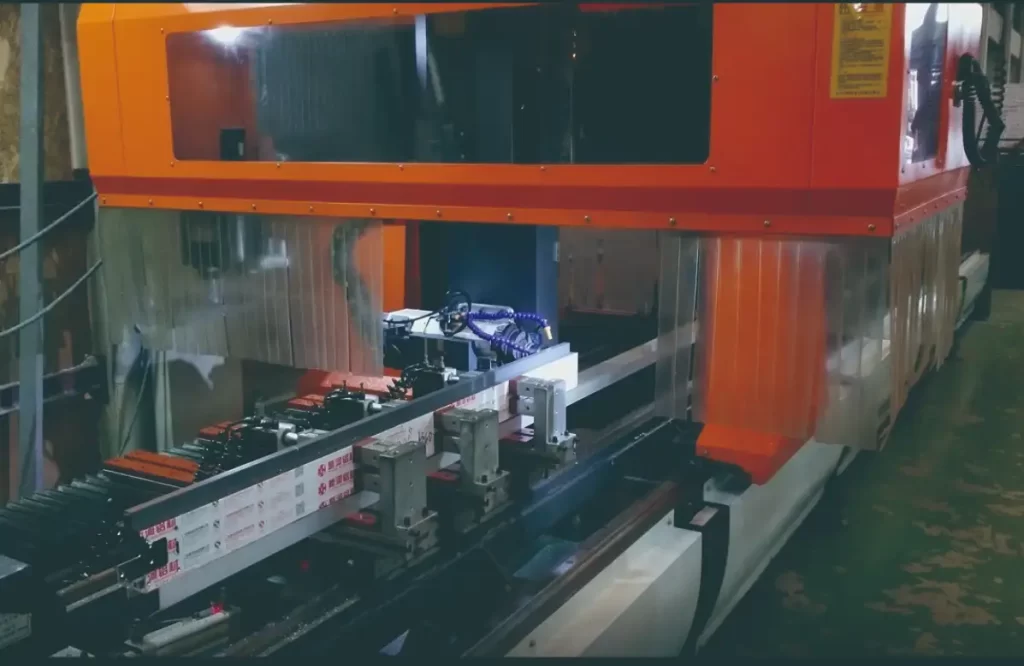
2.1 How It Works
The spindle points vertically downward, with the workpiece mounted on a horizontal table. Most VMCs operate on 3 axes (X, Y, Z), though 4th- or 5th-axis add-ons are common for complex contours.
Typical specs:
- Spindle speed: 6,000–24,000 RPM (up to 40,000+ for high-speed machining)
- Table size: 500×1000 mm to 1200×2500 mm
- Tool capacity: 16–60 tools, with tool changes in 1.5–3 seconds
2.2 Where It Shines
- Space efficiency: Fits in 6–8 m²—ideal for crowded shops
- Ease of use: Intuitive setup; operators train in days, not weeks
- Cost-effective: Entry-level 3-axis VMCs start around $50K–$85K USD
- Rapid changeovers: Perfect for job shops handling 5–10 part numbers daily
2.3 Ideal Applications
- Flat plates (brackets, heat sinks, enclosures)
- Shell-type components (motor housings, sensor covers)
- Prototypes and low-volume batches
- Materials: aluminum, plastics, brass, mild steel (<30 HRC)
Thanks to open access and straightforward fixturing, VMCs excel at machining cnc milling parts, cnc plastic machine components, and cnc metal cutting jobs where visibility and quick adjustments matter.
2.4 Key Limitations
- Chip evacuation struggles: Chips pool in deep cavities, risking surface damage (Ra can degrade by 0.8–1.6 μm)
- Multi-face inefficiency: A 5-sided part requires 3+ setups, accumulating ±0.02 mm error per re-clamp
- Limited rigidity: Overhanging tools in Z-axis reduce max depth of cut (typically ≤20 mm in steel)
3. Horizontal Machining Center (HMC): The High-Volume Powerhouse
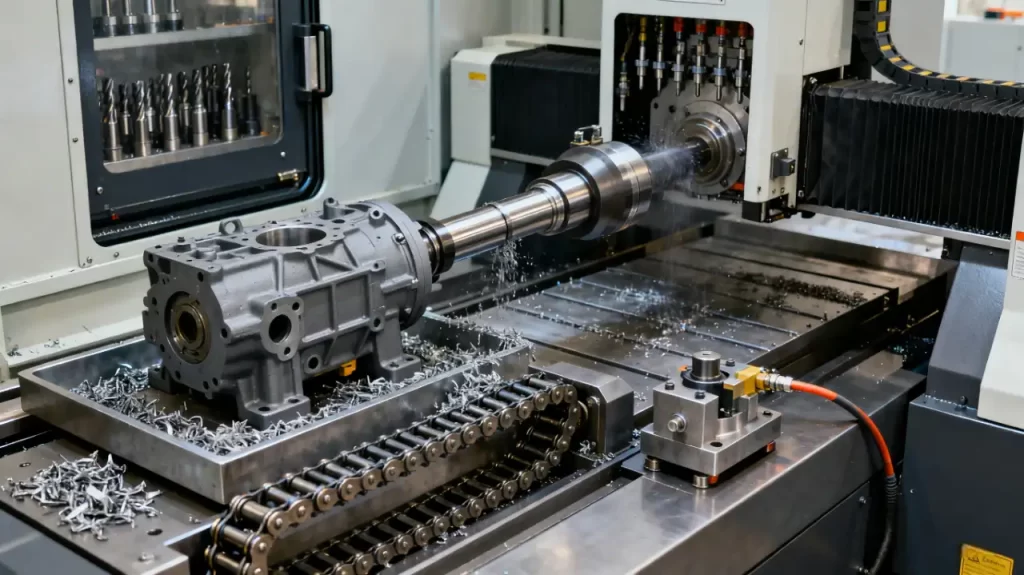
3.1 How It Works
The spindle runs horizontally, and the workpiece rotates on a B-axis pallet. Paired with dual-pallet systems, HMCs enable “machine while you load”—a game-changer for unattended production.
Typical specs:
- Spindle torque: High-torque design (up to 300 N·m) for heavy cuts
- Pallet size: 500×500 mm or 630×630 mm
- Chip management: Gravity-fed chips fall cleanly away—no manual clearing
3.2 Where It Dominates
- Superior chip control: Extends tool life by 30–40% in cast iron
- True 5-face machining: One setup completes front, back, left, right, and top
- Automation-ready: Native compatibility with robots, FMS, and MES
- High OEE: Achieves 85%+ equipment efficiency vs. 65–70% for VMCs
3.3 Ideal Applications
- Box-shaped parts (transmission cases, valve bodies)
- Aerospace structural components
- Medical implants requiring tight tolerances
- Materials: cast iron, stainless steel, Inconel, titanium
In high-stakes sectors like cnc machining aerospace and cnc machining medical, HMCs are non-negotiable. Their ability to hold ±0.005 mm tolerances across complex geometries—while running lights-out—justifies the premium.
3.4 Key Trade-offs
- Higher cost: Starts at $170K–$350K+ USD
- Larger footprint: Needs 12–20 m² plus robot clearance
- Complex fixturing: Custom pallets and tombstones add $5K–$10K per part family
- Lower flexibility: Hard to justify for shops with highly variable part mixes
4. Head-to-Head: VMC vs. HMC Decision Matrix
| CRITERIA | VERTICAL MACHINING CENTER (VMC) | HORIZONTAL MACHINING CENTER (HMC) |
|---|---|---|
| Initial Investment | $50K–$85K | $170K–$350K+ |
| Footprint | 6–8 m² | 12–20 m² |
| Setup Complexity | Low (standard vises, vacuum tables) | High (custom pallets, hydraulic fixtures) |
| Multi-Face Machining | Weak (3+ setups for 5 sides) | Strong (1 setup, B-axis indexing ±5″) |
| Chip Evacuation | Poor (manual intervention needed) | Excellent (gravity + chain conveyor) |
| Automation Potential | Limited (basic robot loading) | High (FMS, AGV, full lights-out) |
| Ideal Batch Size | 1–500 pcs/year | 1,000+ pcs/year |
| Best Materials | Aluminum, plastics, brass | Cast iron, stainless, high-temp alloys |
Note: Based on 630×630 mm work envelope, 2025 China market pricing.
5. The Procurement Lens: Making a Data-Driven Choice
5.1 Match the Machine to Your Part Geometry
- Flat, 2.5D parts? → VMC
- Cubic, multi-featured parts? → HMC
5.2 Run the Numbers: Break-Even Analysis
Assume:
- VMC part cost: $100
- HMC part cost: $60
- HMC premium: $80,000
Break-even volume = $80,000 / ($100 – $60) = 2,000 parts → If you run >2,000 pcs/year, HMC wins on cost alone.
5.3 Think Beyond the Machine: Total Cost of Ownership (TCO)
Factor in:
- Fixturing
- Tooling
- Labor (HMCs often need fewer operators)
- Downtime (VMCs have simpler maintenance)
A real-world case: Over 5 years, an HMC’s TCO was 18% lower per part despite 2× higher upfront cost—thanks to 2.3× higher output.
6. Emerging Trends & Smart Strategies
6.1 Hybrid Approach: Best of Both Worlds
Many shops now run:
- VMCs for prototyping and low-volume work
- HMCs for production ramp-up
This “VMC-to-HMC” workflow cuts time-to-market by 40% in industries like EV power electronics.
6.2 Don’t Overlook 5-Axis VMCs
Modern 5-axis VMCs blur the lines—handling complex aerospace impellers or medical joints. But for heavy roughing or cast iron, HMCs still rule.
6.3 Actionable Next Steps
- Profile your part mix: Track geometry, material, volume, and tolerance over 12 months
- Request a tryout: Have vendors machine your actual parts—measure cycle time and surface finish
- Model TCO: Include labor, tooling, and scrap rates—not just machine price
- Future-proof: If automation is in your 3-year plan, HMC’s scalability pays off
7. The Bottom Line: There’s No “Best”—Only “Best Fit”
VMCs and HMCs aren’t competitors—they’re complementary tools in a smart manufacturer’s arsenal.
- Choose a VMC if: You value flexibility, low entry cost, and fast changeovers for diverse, low-to-medium volume work.
- Choose an HMC if: You chase throughput, consistency, and automation for high-volume, high-complexity production.
As one veteran plant manager puts it: “Don’t buy the most expensive machine—buy the one that turns your biggest bottleneck into your strongest asset.”
Industry Use Case Snapshot
INDUSTRY RECOMMENDED MACHINE WHY Mold & Die VMC (5-axis) Complex contours, frequent design changes Automotive Powertrain HMC High-volume, cast iron, 5-face machining Aerospace HMC or 5-axis VMC Tight tolerances, exotic materials Consumer Electronics VMC Aluminum/brass, high mix, low volume Medical Devices HMC Traceability, repeatability, cleanroom compatibility
In the end, the right choice isn’t about specs—it’s about strategy. Pick the machine that aligns with your business model, not just your budget.